
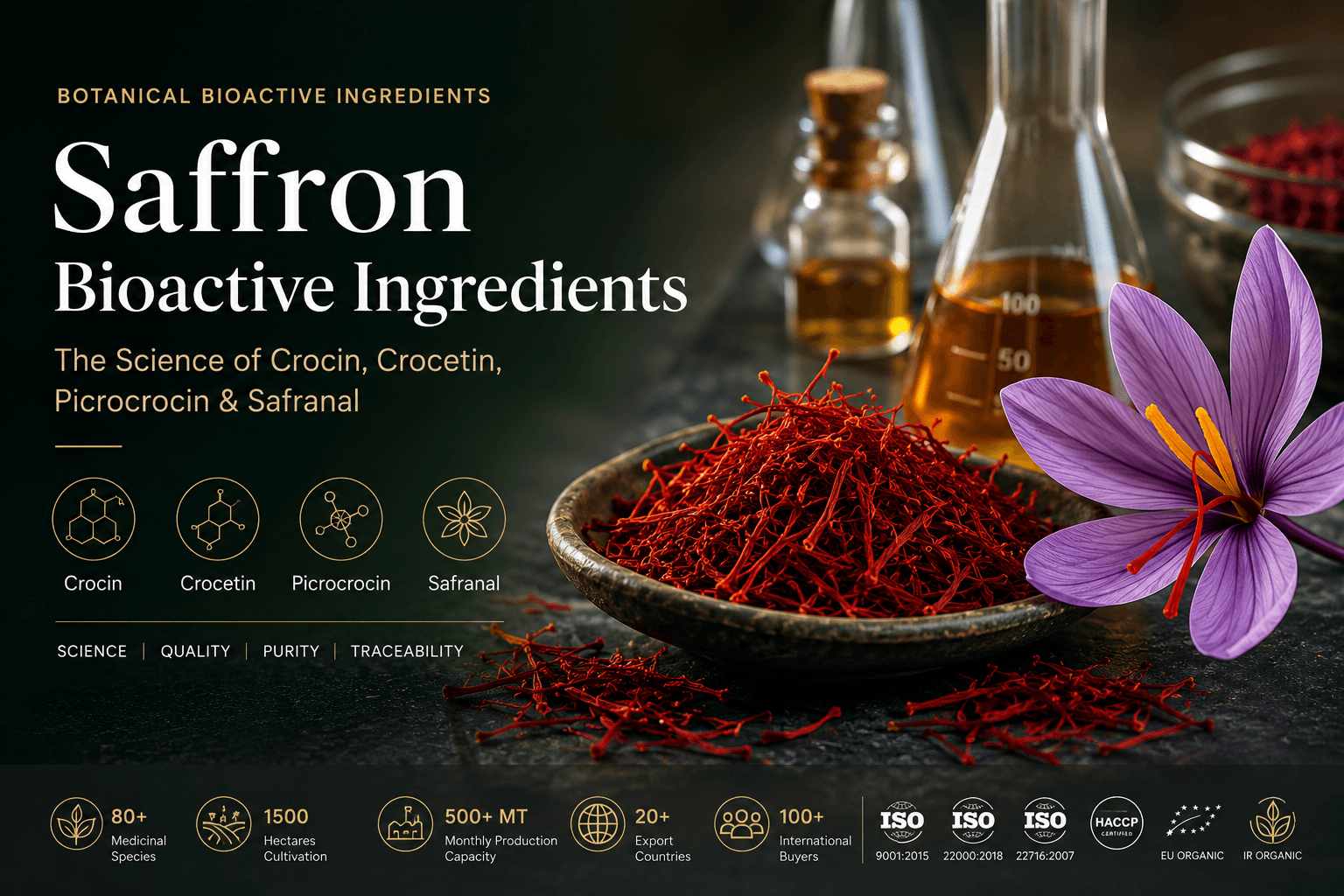
Saffron Bioactive Ingredients: Crocin, Crocetin & Safranal
Explore saffron chemical composition through crocin, crocetin, picrocrocin and safranal. Compare their roles, stability, analysis and bulk ingredient applications.
Botanical Bioactive Ingredients
Saffron Bioactive Ingredients:Crocin, Crocetin, Picrocrocin & SafranalA phytochemistry-first look at saffron's four key apocarotenoids — how they form, how they're measured, and how they're standardized into pharmaceutical, food, and cosmetic-grade ingredients.
Crocin Crocetin Picrocrocin Safranal Apocarotenoids
What Are Saffron Bioactive Ingredients?
Crocus sativus L. (saffron) contains a distinctive group of bioactive compounds that contribute to its characteristic color, taste, aroma, and functional properties. The most important saffron constituents include Crocin, Crocetin, Picrocrocin, and Safranal.
From a phytochemical perspective, saffron chemical composition is particularly characterized by these apocarotenoids and their derivatives. Crocin and Crocetin are primarily associated with saffron's color-related properties, while Picrocrocin contributes to its characteristic bitter taste and serves as a precursor to Safranal, the principal volatile compound associated with saffron aroma.
For manufacturers, formulators, and R&D teams, understanding these saffron bioactive ingredients is important when selecting saffron-derived raw materials. Unlike raw saffron, a standardized saffron extract or purified bioactive ingredient can be supplied with a defined specification, analytical method, and verified active content, allowing formulation teams to evaluate consistency from batch to batch.
This distinction is particularly relevant to pharmaceutical, nutraceutical, food, beverage, and cosmetic applications, where the required compound, concentration, solubility, stability, and analytical specification can vary according to the formulation and end use.
In this guide, we examine the four key saffron bioactive ingredients — Crocin, Crocetin, Picrocrocin, and Safranal — including their chemical characteristics, biosynthetic relationships, analytical considerations, stability, and applications as standardized botanical ingredients.
The Four Key Phytochemicals: crocin & safranal
Crocin: Chemical Structure & Classification
Crocin is a water-soluble carotenoid — technically a glycosyl ester of crocetin, formed when crocetin's two carboxylic acid groups are esterified with sugar units (typically gentiobiose). That glycosylation is what makes Crocin soluble in water, unlike most carotenoids, which are fat-soluble. Structurally, Crocin belongs to the apocarotenoid class: a carotenoid that has been enzymatically cleaved from a longer carotenoid backbone, in this case zeaxanthin. This water solubility is precisely why Crocin performs well as a natural colorant in aqueous food and beverage systems where oil-soluble carotenoids would not disperse.
Crocin vs. Crocetin: What's the Difference?
Crocetin is the unglycosylated core molecule; Crocin is crocetin with sugar chains attached. In practice, this distinction matters for procurement:
Property Crocin Crocetin Structure Crocetin + glycoside chains Unglycosylated diterpene core Solubility Water-soluble Lipid-soluble Typical use Aqueous food, beverage, cosmetic systems Lipid-based and research formulations
Source context: Fernández-Albarés et al., "The Pharmacological Activities of Crocus sativus L."
Picrocrocin Explained
Picrocrocin is a bitter monoterpene glycoside and the compound primarily responsible for saffron's characteristic taste. It is itself a degradation product of zeaxanthin, and it plays a second, equally important role: it is the direct biosynthetic precursor of Safranal. As saffron stigmas dry, the enzyme β-glucosidase acts on Picrocrocin to release its aglycone, HTCC (4-hydroxy-2,6,6-trimethyl-1-cyclohexene-1-carboxaldehyde), which then dehydrates into Safranal.
Safranal: Formation & Biosynthesis
Safranal (C₁₀H₁₄O, a monoterpene aldehyde) is the volatile compound behind saffron's aroma and typically makes up roughly half of the essential oil fraction in well-cured saffron. It is not present in meaningful quantities in freshly harvested stigmas — it develops during drying and post-harvest storage, as heat and enzymatic activity convert Picrocrocin through the HTCC intermediate into Safranal. This is why drying conditions (temperature, duration, humidity) are treated as a critical control point in saffron processing, not just for the raw spice but for any downstream Safranal extraction.
Source context: ScienceDirect Topics — Safranal; Picrocrocin overview; Ordoudi et al., drying & volatile compound development in saffron
Biosynthesis at a Glance: From Zeaxanthin to Four Active Compounds
Zeaxanthin Crocetin Crocin (glycosylated) Picrocrocin HTCC intermediate (drying / dehydration) Safranal
Simplified schematic for formulator reference; not to scale. Based on biosynthesis pathways described in the cited sources above.
Mechanism of Action: Antioxidant Activity & Oxidative Stress
Note: the findings summarized below come from published research on the isolated compounds. They describe the scientific literature, not a health claim for any ZHEEK HERB product — our ingredients are supplied as raw materials for formulators to test, dose, and substantiate within their own finished products.
Crocin's antioxidant activity has been studied at the mechanistic level using pulse-radiolysis and molecular simulation methods, which found that Crocin reacts rapidly with hydroxyl radicals (OH•) and can act as both a direct free-radical scavenger and, through hydrogen-atom transfer, an indirect antioxidant that helps restore nearby oxidized molecules. A 2024 systematic review and meta-analysis of randomized clinical trials similarly reported that Crocin supplementation was associated with a measurable increase in total antioxidant capacity across pooled trial data, although the same review noted that evidence for some other inflammatory markers remained inconclusive — a useful reminder that "antioxidant" and "anti-inflammatory" activity are supported to different degrees depending on the specific biomarker studied.
Safranal has also been reported in the literature to show antioxidant and free-radical-scavenging properties in vitro, alongside other pharmacological activities under investigation. As with Crocin, bioavailability and dose-response depend heavily on delivery format, which is one reason standardized extracts (documented purity, defined solvent system, verified assay) are preferred over undocumented raw material for research and product development.
Sources: Lampre et al., MDPI Antioxidants (2023); Crocin Supplementation on Inflammation and Oxidative Stress: Systematic Review & Meta-Analysis, PubMed (2024); ScienceDirect Topics — Safranal
Stability & Storage Considerations
All four compounds are degradation-sensitive, which is why extraction, purification, and packaging conditions are treated as quality-control variables, not just processing steps. Published research on saffron's post-harvest chemistry identifies three consistent stress factors:
Heat accelerates degradation of both Crocin (color) and Safranal (aroma); elevated temperature during storage or transport is one of the fastest ways to lose potency.
Moisture / water activity reactivates enzymatic reactions in raw material and speeds pigment decomposition in processed extracts alike.
Light exposure, particularly UV, contributes to oxidative breakdown of the carotenoid structure over time.
In practice, this means formulators should request storage guidance alongside the certificate of analysis for any Crocin, Safranal, or standardized extract shipment, and should factor stability into shelf-life testing for the finished product rather than assuming the raw ingredient's stated purity holds indefinitely.
Sources: Ordoudi et al., drying conditions & volatile development, MDPI Molecules (2021); Shelf-life determination of saffron stigma, World Applied Sciences Journal
Preclinical & Clinical Research Snapshot
Beyond antioxidant activity, a broader pharmacological review of Crocus sativus phytoconstituents catalogues research into anti-inflammatory, cardioprotective, neuroprotective, hypolipidemic, and antihyperglycemic activity for Crocin and Crocetin, alongside antimicrobial and radical-scavenging properties for Safranal — while the same review is explicit that pharmacokinetic studies, new delivery formulations, and drug-interaction data are still needed before many of these findings translate into approved therapeutic use. That caveat matters for procurement teams: research interest in a compound is not the same as regulatory approval for a specific health claim, and any claims made on a finished product remain the responsibility of the brand bringing that product to market in its target jurisdiction.
For R&D teams evaluating saffron-derived actives, this body of research is most useful as a starting point for their own substantiation work — informing which grade, format, and dose range is worth testing — rather than as a ready-made marketing claim.
Source: The Pharmacological Activities of Crocus sativus L., PMC (open access review)
From Stigma to Standardized Ingredient: Manufacturing Workflow
Because each compound is chemically distinct — water-soluble glycoside vs. volatile monoterpene — ZHEEK HERB matches the extraction method to the target molecule rather than running every batch through a single generic process:
Raw Stigma Selection & Traceability Extraction UAE / Ethanol / CO₂ / Steam Purification Membrane & Chromatography Concentration Low-Temp Vacuum QC & Packaging HPLC / GC-MS Verified
Product Active / Assay Method Solubility Applications Crocin – Pharma Grade ≥ 99% HPLC Water Soluble Pharma research, advanced nutraceuticals Crocin – Food Grade ≥ 40% HPLC Water Soluble Functional beverages, food formulations Safranal ≥ 90% GC-MS Oil / Ethanol Flavor, fragrance, cosmetic formulations Powder / Liquid Extract Crocin, Safranal, Picrocrocin UV-Vis / HPLC Powder / Liquid Supplements, syrups, food premixes
Customized purity levels, extract ratios, and ingredient specifications are available on request.
Formulating with Crocin, Safranal, or standardized saffron extract? Get the certificate of analysis before you commit to a spec.
Industrial Applications by Sector
The same four compounds serve very different formulators depending on grade and format: pharmaceutical teams typically specify Pharma Grade Crocin (≥99% HPLC) for research-grade consistency; food and beverage manufacturers work with Food Grade Crocin as a natural colorant and standardized extracts as functional-ingredient premixes; and cosmetic formulators use Cosmetic Grade Crocin and Safranal as natural antioxidant and aromatic actives in skincare bases.
Alongside the saffron line, our broader Processed Botanical Ingredients range gives formulators a single source for other standardized plant extracts, distillates, and oils used across the same three industries.
A Note on Regulatory Considerations
Regulatory status for saffron-derived colorants, flavors, and actives varies by market and by end-use category — food colorant approval, cosmetic INCI listing, and pharmacopoeial monograph requirements are each governed separately, and requirements differ between the EU, GCC, CIS, and other export markets. ZHEEK HERB provides the analytical documentation (HPLC/GC-MS assay, purity certification) formulators need to run their own regulatory assessment; we recommend confirming category-specific approval status with a regulatory specialist in your target market before finalizing a formulation.
Buyer Checklist: Before You Order Saffron Bioactive Ingredients
Confirm the compound you need — Crocin (color), Safranal (aroma), or a full-spectrum standardized extract.
Match purity tier to end-use category (pharma, food, or cosmetic grade).
Request the assay method and certificate of analysis (HPLC / GC-MS / UV-Vis) for every batch.
Ask for storage/stability guidance and factor it into your own shelf-life testing.
Verify regulatory status for your target market and use category before finalizing a formulation.
Confirm MOQ, lead time, packaging, and logistics directly with our export team for your target volume.
Quality Assurance & Global Partnership
Production runs under ISO 9001 and ISO 22000 quality systems, with raw material traceability, controlled extraction, and batch-level analytical verification. As a direct manufacturer with a portfolio of 80+ botanical species, we work with procurement teams, formulators, and R&D groups across Germany, the UAE, Turkey, Russia, China, and Pakistan to develop saffron ingredients matched to specific industrial applications.
Request a Technical Data Sheet Get a Wholesale Quote Talk to Our Export Team
How to Select the Right Crocin Grade for Your Formulation
1
Define the application first. Pharmaceutical research and advanced nutraceuticals typically require Pharma Grade Crocin; food and beverage formulations work with Food Grade; cosmetic actives use Cosmetic Grade.
2
Match the purity tier to your target. Compare your formulation's required active concentration against the ≥99%, ≥40%, and ≥20% tiers before requesting samples.
3
Verify the assay method. Every Crocin batch is confirmed by HPLC — request the certificate of analysis alongside your quote so your QA team can validate it against your specification.
4
Check stability requirements against your shelf-life target. Ask for storage guidance and factor heat, moisture, and light exposure into your own product's shelf-life testing.
5
Request a custom specification if needed. Customized purity levels and extract ratios are available on request for non-standard formulations.
How to Source Standardized Saffron Extract for Bulk Formulation
1
Choose the extract format. Powder extract suits capsules, tablets, sachets, and dry premixes; liquid extract suits beverages, nutraceutical liquids, and medicinal syrups.
2
Specify your target actives. Standardized saffron extract is verified for Crocin, Safranal, and Picrocrocin together via UV-Vis/HPLC — confirm the ratio your formulation needs.
3
Request samples and documentation. Ask for analytical verification records and batch consistency data before committing to a production run.
4
Confirm logistics before ordering. Align minimum order quantity, packaging, and delivery timeline with your export team ahead of your first bulk purchase order.
Frequently Asked Questions
What are the main bioactive compounds in saffron?
The main bioactive compounds and characteristic constituents of saffron (Crocus sativus L.) include Crocin, Crocetin, Picrocrocin, and Safranal. Crocin and Crocetin are primarily associated with saffron's color, while Picrocrocin contributes to its characteristic taste and Safranal is a major volatile compound associated with its aroma.
What is the chemical composition of saffron?
Saffron's chemical composition includes several classes of phytochemicals, with Crocin, Crocetin, Picrocrocin, and Safranal among its most characteristic bioactive constituents. Their relative levels can vary depending on factors such as saffron quality, drying conditions, processing, extraction, and storage.
What is the chemical structure of Crocetin?
Crocetin is an apocarotenoid compound and the unglycosylated core structure related to Crocin. Unlike Crocin, which contains attached sugar units and is water-soluble, Crocetin has no glycosyl groups and has substantially different solubility characteristics.
What is Picrocrocin in saffron?
Picrocrocin is a bitter monoterpene glycoside responsible for much of saffron's characteristic taste. During drying and post-harvest processing, Picrocrocin can contribute to the formation of Safranal through the HTCC intermediate.
What is the difference between Crocin and Safranal?
Crocin is a water-soluble apocarotenoid associated primarily with saffron's color, while Safranal is a volatile monoterpene aldehyde associated with saffron's characteristic aroma. Because they differ chemically and functionally, they require different extraction, analytical, and storage considerations.
Which compound gives saffron its color?
Crocin and related crocetin derivatives are primarily responsible for saffron's characteristic yellow to red-orange color. Crocin's glycosylation also gives it greater water solubility than many other carotenoid compounds.
Which compound gives saffron its aroma?
Safranal is the principal volatile compound associated with saffron's characteristic aroma. It develops during post-harvest processing, particularly during drying, through pathways involving Picrocrocin and the HTCC intermediate.
How is Crocin content in saffron measured?
Crocin content can be evaluated using analytical techniques such as HPLC and UV-Vis spectroscopy, depending on the material, specification, and analytical purpose. For standardized botanical ingredients, buyers should request the applicable assay method and batch-specific Certificate of Analysis.
What is the difference between Crocin and Crocetin?
Crocetin is the unglycosylated core molecule, while Crocin is a glycosylated derivative containing sugar units. This structural difference gives Crocin substantially greater water solubility and makes it particularly relevant to aqueous formulations.
Are standardized saffron ingredients available for bulk formulation?
Yes. ZHEEK HERB supplies saffron-derived ingredients including Crocin Active, Safranal Active, Saffron Powder Extract, and Saffron Liquid Extract for bulk and industrial applications. Specifications, analytical documentation, and customized requirements can be discussed with the export team.
What purity grades of Crocin does ZHEEK HERB offer?
ZHEEK HERB offers Crocin in different specification levels for industrial applications, including Pharmaceutical Grade, Food Grade, and Cosmetic Grade. Each specification is associated with an applicable assay and quality documentation.
How should saffron bioactive ingredients be stored?
Saffron bioactive ingredients should generally be protected from excessive heat, moisture, and light, as these conditions can affect the stability of compounds such as Crocin and Safranal. Storage requirements should be confirmed against the specific ingredient specification and supplier documentation.
What documentation should buyers request for standardized saffron ingredients?
Buyers should request the Certificate of Analysis, assay method, active compound specification, purity information, storage requirements, and relevant quality documentation for each batch. These documents allow R&D and quality teams to evaluate consistency before bulk procurement.
Which industries use standardized saffron ingredients?
Standardized saffron ingredients are relevant to pharmaceutical, nutraceutical, food and beverage, and cosmetic applications. The appropriate compound, purity level, format, and analytical specification depend on the intended formulation and end use.
References & Further Reading
The Pharmacological Activities of Crocus sativus L. — PMC (open access review)
Unveiling the Intimate Mechanism of the Crocin Antioxidant Properties by Radiolytic Analysis and Molecular Simulations — MDPI Antioxidants (2023)
Crocin Supplementation on Inflammation and Oxidative Stress: A Systematic Review and Meta-Analysis — PubMed (2024)
Safranal — ScienceDirect Topics
Picrocrocin overview — Wikipedia
The Relation between Drying Conditions and the Development of Volatile Compounds in Saffron — MDPI Molecules (2021)
Shelf-life Determination of Saffron Stigma — World Applied Sciences Journal